Getting your head around Scotland’s history involves an understanding of what I call the ‘three ‘Rs’ of Scottish history: ‘Race’, Royalty and Religion.
Starting with the first, ‘Race’ - something of a dirty word, and it’s not quite what I mean (I needed an ‘R’…): I’m really talking about Scottish national identity and culture. The first thing any Scot will be very quick to point out to you (especially if you get it wrong!) is that we are not ‘English’. The English are the ‘other’ against whom the Scots tend to define themselves. We share the same island (Great Britain) and even, since 1707, the same political state (the United Kingdom), but before political union with England, the normal state of things between our two countries was one of conflict. England’s population is about 10 times the size of Scotland’s, and in the long wars fought by Scots to prevent their much more powerful next-door neighbour from taking over, Scots have forged one of the earliest emergent national identities in the world, and it endures to this day.
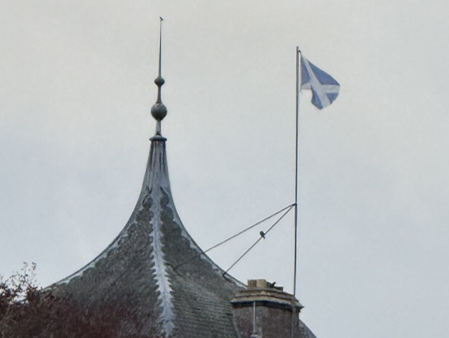
The Saltire Cross, Scotland’s national flag, flies proudly above Thirlestane Castle
Now (and this is super-simplistic), by the 1600s, Scotland’s cultural landscape had split into two important and distinct groups, with the dividing line being a geological fault line running diagonally from the south-west to the north-east (see the map below). This ‘Highland Boundary Fault Line’ splits the mountainous Scottish Highlands above it, from the lowlands of the ‘Central Belt’ below it.
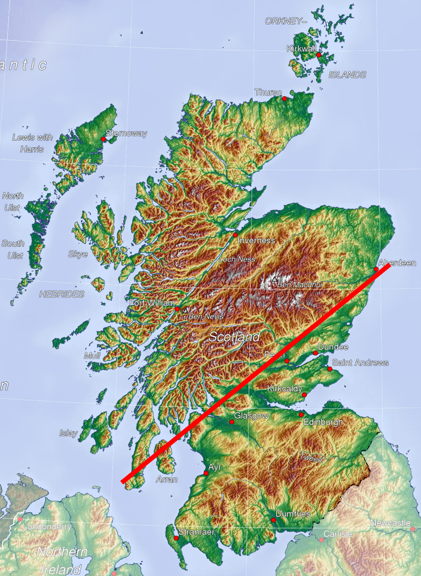
Relief map of Scotland showing the Highland Boundary Fault Line
North of this line, society was essentially ‘tribal’, with people speaking an old Celtic language – Scottish Gaelic (pronounced ‘Gallic’) – which was very similar to Irish Gaelic (pronounced ‘Gay-lic’); after all, connections between Scottish and Irish Gaeldom were always very close. This was an ‘oral’ culture that recounted its legends and histories through poetry and song.
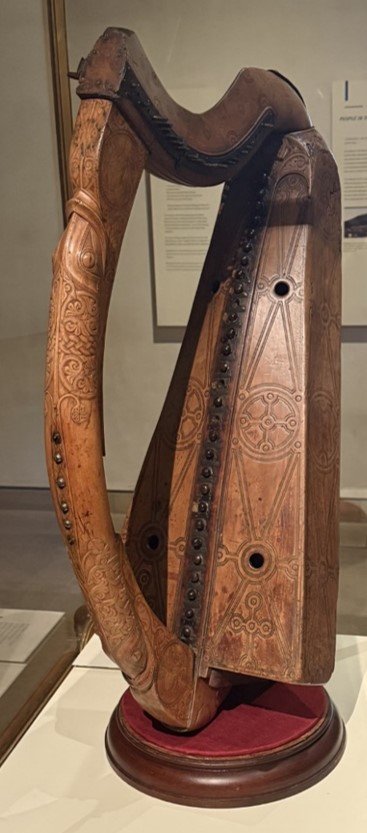
A clàrsach from the 1500s – the primary instrument of Gaelic courtly music
In the Gaelic-speaking world (or ‘Gaeltacht’), people grouped themselves for protection around powerful chieftains and told each other that they were all descended from the same common ancestor. Indeed, the Gaelic word ‘clan’ means ‘children’. In this mountainous area, the soil was too poor to sustain the population all year round so clan chiefs made money by hiring out their young men of fighting age for mercenary service during the summer. In the 1500s this service tended to be in Ireland as ‘foreign warriors’ or ‘gallóglach’ (anglicised to ‘Gallowglass’), but by the 1600s the mercenary market increasingly took Scottish highland warriors to Europe.
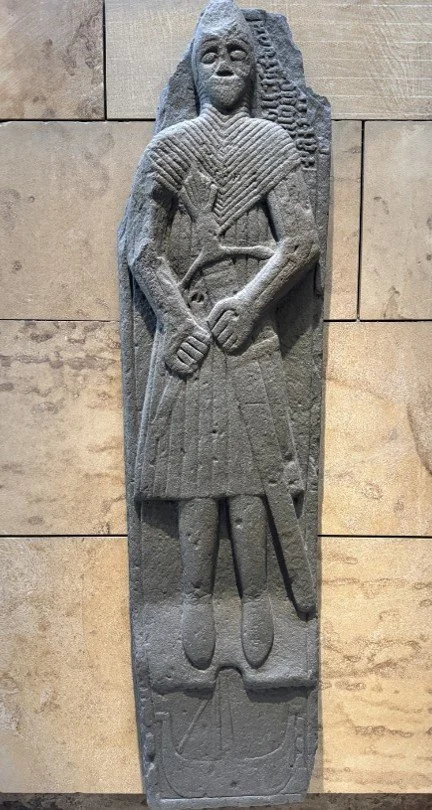
A Gaelic warrior in the 1500s. Note the ship or ‘Birlinn’ at the bottom, which would have conveyed him swiftly to Ireland – its appearance a ‘nod’ to Viking influence on the western seaboard of Scotland
The law gave clan chiefs draconian rights of ‘pit or gallows’ over their people, and the ready availability of a trained, experienced warrior class at the clan chief’s ‘beck and call’, combined with a new sense that the Gaeltacht was culturally ‘other’ from rest of Scotland would lead to problems as the Scottish and later British crown tried to exert control over the region.
South of the Highland Boundary Fault Line, the landscape was softer and more fertile, communications were easier, so the King could exert more control. Since the early 1100s, the Lowland region had seen the establishment of planned market settlements or ‘Burghs’ (pronounced ‘boroughs’). Some of these Burghs were designated ‘Royal Burghs’, meaning they could engage in international trade.
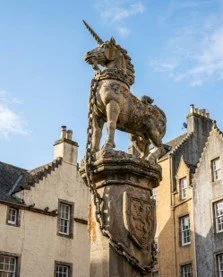
The Unicorn atop the ‘Mercat Cross’ – symbol of a town’s status as a ‘Royal Burgh’
The Royal Burghs, mostly in the east of the country, were a window on cosmopolitan Europe, home to colonies of merchants from Flanders, Demark and Norway, the Baltic, France, and, when there was peace, even England. Despite its place on the northern periphery of Europe, Scotland was firmly embedded in the consciousness of Europeans, whether in Rome, Paris, Veere in Flanders (where there was a Scottish commercial hub or ‘staple’), Sweden or Geneva.
Four hundred years ago, the language of the Lowlands was ‘Scots’: an Anglo-Saxon language, Scots was different to the English (admittedly rich with Scottish accent and vocabulary) spoken by most Scots today. Here’s an example of old Scots from an epic poem written in the late 1300s. In early 1314, King Robert the Bruce assaulted the English garrison Edinburgh Castle, led by a guide, William Francis. Here Francis describes how he knows a route up the cliffs because he used to sneak out to visit his girlfriend in the town below:
“Quhen I wes young this hendre day
My fader wes kepar of yone hous,
And I wes sumdeill valegous
And lovyt a wench her in the toun,
And for I but suspicion
Mycht repayr till hyr prevely
Off rapys a leddre to me mad I
And tharwith our the wall I slaid
A strait roid that I sperit had
Intill the crag syne doun I went
And oftsys come till myn entent,
And quhen it ner drew to the day
Ik held again that ilk way
And ay come in but persaving
Ik usyt lang that traveling
Sua that I kan that roid ga rycht”
This is a gentle introduction to old Scots. It can be incomprehensible to English speakers, but even by the time that our great Scots ‘bard’ Robert Burns was writing his poems in the late 1700s, Scots had softened a great deal. This is largely because the Union with England was forcing Scots to adapt and interact.
Scotland had been its own largely united kingdom from the creation of ‘Alba’ in the 900s, and especially after the eviction of the Vikings from 1263. Robert Bruce and many in Lowland Scotland would have been quite comfortable speaking Gaelic as well as old ‘Scots’, and Bruce counted the MacDonalds among his loyal troops at his famous victory at Bannockburn in 1314.
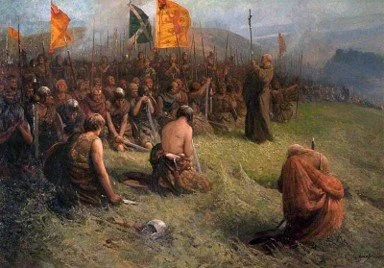
This early 20th Century depiction of Bannockburn accurately shows that Gaelic speaking clansmen fought for Bruce, but they wouldn’t have been dressed in kilts like this…
The cultural divide between the Gaeltacht and Lowland Scots started to grow only from the late 1500s, and the divide has softened again as Scots reconstruct their identity in the 21st Century.
So are Scots ‘British’? Well, much depends on who you ask, the period of history you’re living in, and how the respondent feels about Scottish independence. It is possible to be both, but one thing is pretty certain: whether a Scot describes themselves as ‘British first, then Scottish’, or ‘Scottish first, then British’, or simply ‘Scottish’, it would be an ‘unco’ (Scots for ‘extraordinary’) thing to find a Scot describing themselves as just ‘British’. In the late 1400s, the French would describe someone as being ‘fier comme ung Escossoys’ (‘as proud as a Scot’). That hasn’t changed….
Coming next, we have the second ‘R’ of Scottish history – the significance of the ruling Royal dynasties to Scotland’s historic pathway.